On 21 November, NODE in Palo Alto will stream a live broadcast of Operator's Act III from the Whitney Museum of American Art in New York. It caps a first year that began in January with every one of the 10,000 CryptoPunks on a single wall. Three more exhibitions followed, and a commercial gallery would have struggled to stage most of them, with even less reason to try.
This matters for collectors because NODE is not a shop. It is a nonprofit, started with a $25 million foundational grant from collectors Micky Malka and Becky Kleiner, The Almanac reported, and it owns the CryptoPunks IP. For artists it is four rooms built from the ground up, including one with a 35 foot LED wall and a ceiling grid and subfloor that can run power and data anywhere. Here is the programme, in order.
10,000: the market on the wall
NODE opened at 180 University Avenue on 23 January 2026 with 10,000, Right Click Save reported. NODE bills it as the first exhibition devoted to CryptoPunks. It came eight months after the foundation bought the full CryptoPunks IP from Yuga Labs in May 2025, for about $20 million according to Right Click Save.
Matt Hall and John Watkinson of Larva Labs led the show as artists, Amanda Schmitt curated it and Natalie Stone led production. Right Click Save described all 10,000 Punks together on the end wall, each custom printed, set on a 24 by 24 grid, projection mapped and filterable by trait. NODE also reminded visitors that the whole thing began as 246 lines of code.
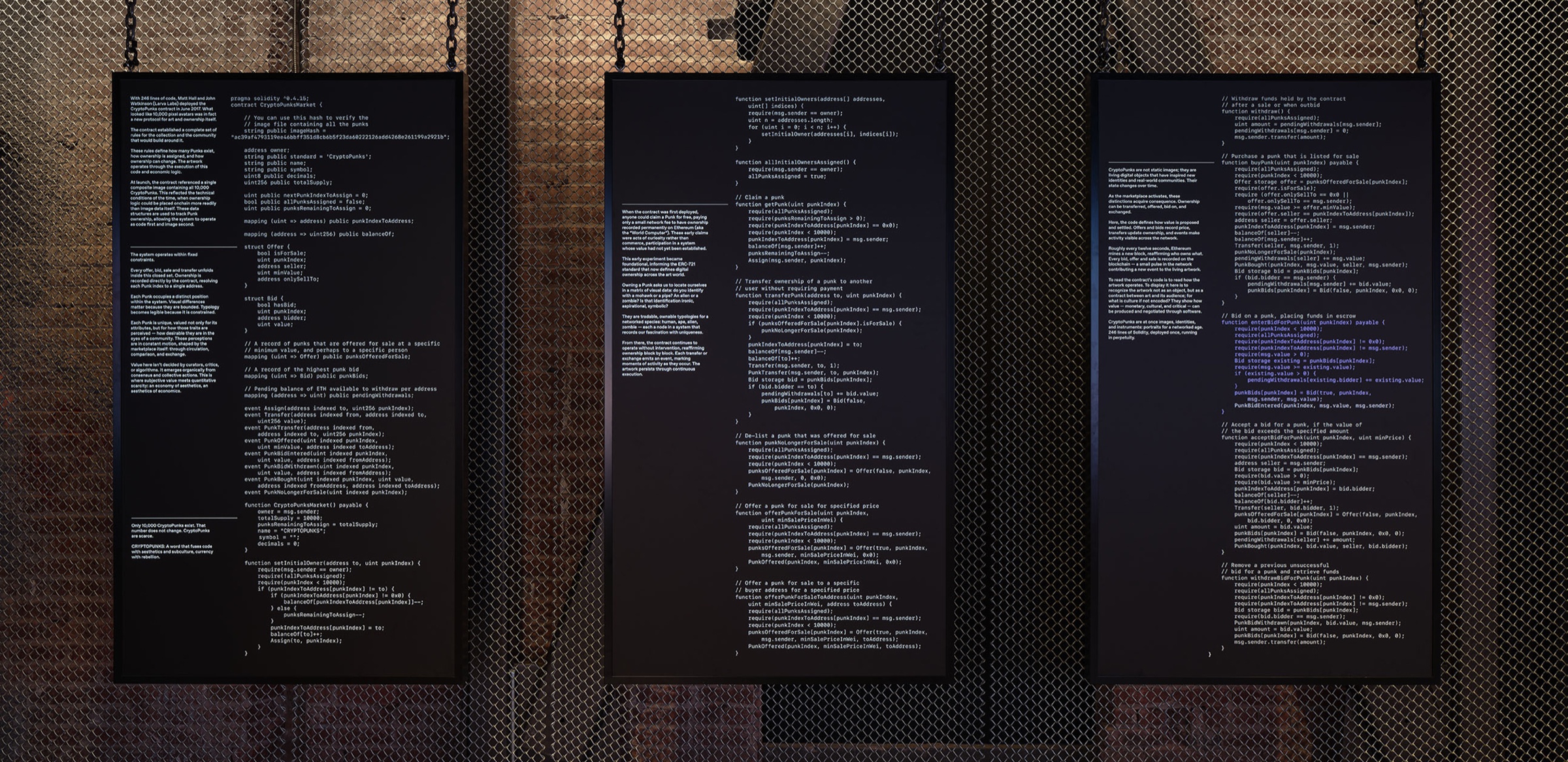
The framing went further than a big hang. NODE presented CryptoPunks as a living artwork, a self-running system with its marketplace as part of the work: every offer, bid, sale and transfer was treated as both an economic event and an aesthetic one. Punk holders have argued this for years. A commercial gallery can't easily say it, because a gallery wants to be the market, not show it. The credits went further still:
“We recognize the global CryptoPunks community as an active part of the artwork itself.” NODE, 10,000 exhibition credits
Why open with Punks? Malka told Le Random: “We couldn't think of a better way to learn or to try this than with CryptoPunks.” NODE has since formed a Punks Advisory Board of Hall and Watkinson, Wylie Aronow of Yuga Labs and Erick Calderon of Art Blocks, according to its CryptoPunks page.
INFINITE_LOOP: Beeple, and the visitors too
BEEPLE: / INFINITE_LOOP ran from 18 April to 28 June as a mid-career survey of Mike Winkelmann. Its backbone was Everydays, the image he has posted every day since 1 May 2007. NODE put the count at more than 6,800 consecutive pieces. Around it were the sculptures: Human One with its six previous chapters, Heaven and Hell, Tree of Knowledge, Transient Bloom, Diffuse Control and Regular Animals.
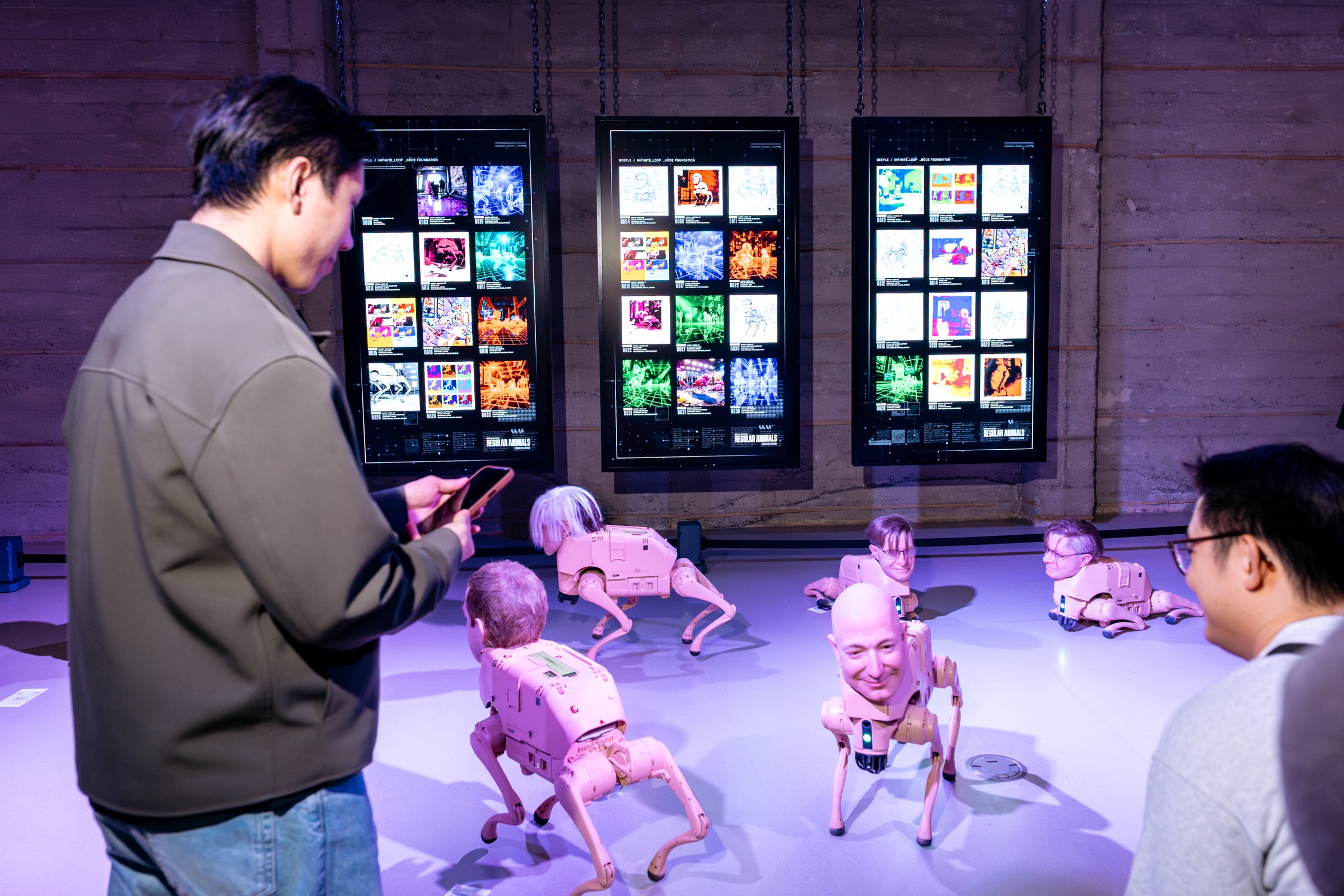
For collectors, the details that mattered were about time and state. Winkelmann can update Human One remotely, in both the sculpture and its paired NFT, for the rest of his life. Tree of Knowledge has a hidden “choose violence” button that can be pressed 666 times before the piece locks into its dystopian state for good. Each Regular Animals robot is due to “die” after three years, and its memories are preserved onchain.
The robot dogs, in latex masks of Elon Musk, Jeff Bezos, Andy Warhol and Pablo Picasso, drew the public in. At the opening, The Almanac reported, their instant photos were handed out bagged as excrement samples. NODE's executive director Phil Mohun told the paper that nearly everyone who sees the dogs pulls out a phone.
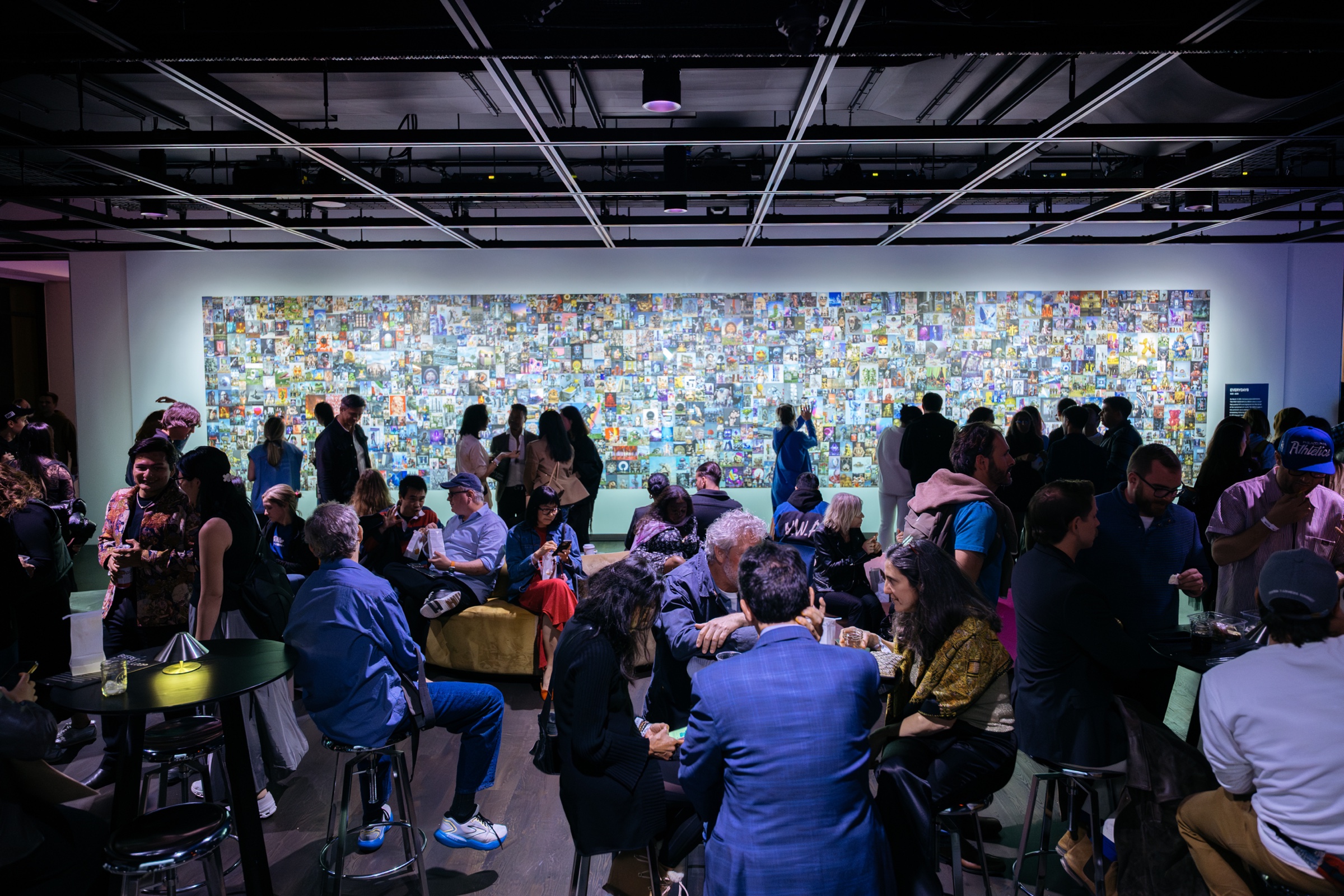
The show also invited visitors to exhibit their own digital work next to the main installation, which NODE said blurred the line between spectator and creator. A dealer with a Beeple show has every reason to keep the walls for Beeple.
PXL: the building as a system
PXL ran from 11 July to 13 September. According to the event listing, Kim Asendorf turned NODE into his PXL ecosystem of DEX, POD and the newest piece, NET, with new PXL tokens open for collecting on site. The San Jose Blog described NET as a vast particle system that needs the full scale of NODE's hardware. The listing shows 1,253 attendees.
What matters here is simple. The work was made for the room, and the collecting happened in the room.
MAKE OUT: the self as software
MAKE OUT, a two-person show by Luke Shannon and Maya Man, ran from 19 September to 8 November. NODE describes it as a look at how the self today is made up of software, screens and social media.
Man showed seven websites from 2022 to 2026, installed like browser tabs floating in space. Shannon brought the plotter-scanner installation from Replacement Character and debuted two new works, For You and Attention Is All You Need. A new joint work linked NODE's two galleries.
It was the quietest show of the year, and it may say the most. A website is awkward stock for a gallery: hard to hang, harder to sell. NODE gave seven of them a room.
Act III: a broadcast, not an object
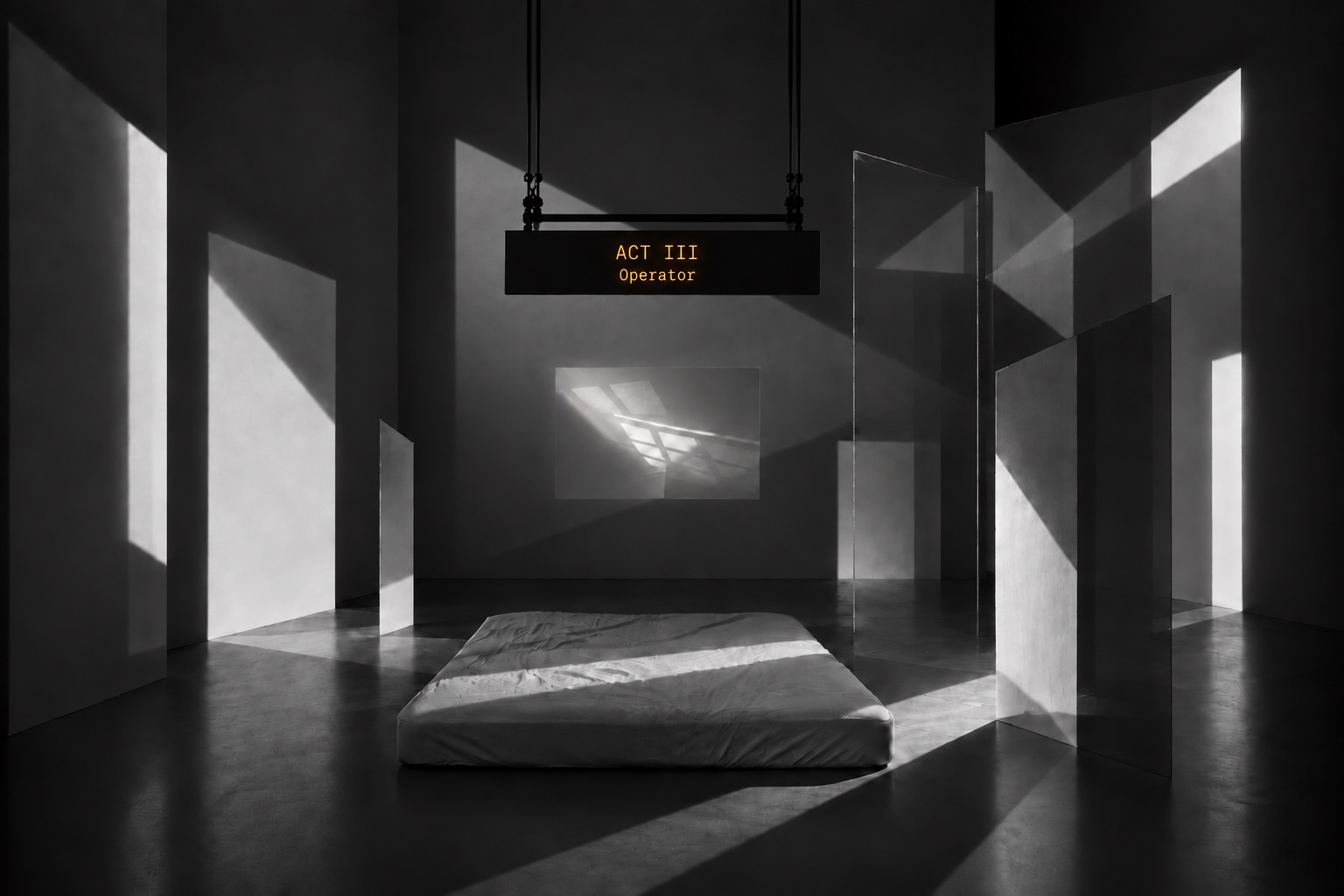
Operator is the duo Ania Catherine and Dejha Ti. Their Human Unreadable Act III premieres at the Whitney, curated by Christiane Paul, with performances on 19, 21 and 22 November. It is the last act of Human Unreadable, a generative choreography work that has unfolded in three acts since 2023. NODE is one of ten venues taking the live broadcast of the 21 November performance. It starts at 10am in Palo Alto, and doors open at 9.30am.
Collectors know Human Unreadable as a series of 400 onchain works, each driven by the motion data of a unique choreographic sequence, as Arab Bank's collection notes explain. Operator says the sequences behind Human Unreadable #2 to #101 will be danced in the show. The duo describe the project as an experiment:
“where the human body enters blockchain art and blockchain art enters the body” Operator, Act III at the Whitney
The museum hosts the premiere, and NODE hosts a room where it can be watched. That fits the name. Malka told Le Random he sees NODE as one point in a network of spaces in major cities. The second, NODE Studio NYC, opened in SoHo in October.
What a dedicated space has shown
Look across the year and every show did something a sales room is not set up to do. 10,000 made the market a subject, not a service. INFINITE_LOOP gave wall space to visitors and showed works whose state changes over years. PXL needed the whole building's hardware. MAKE OUT hung websites. Act III comes to Palo Alto as a stream.
Mohun put the economics plainly to The Almanac. A painting show means taking work down, shipping and rehanging, whereas “with a digital art space, you can change the content on the screens instantly for no cost.” That is how the winter OCCUPY open call worked: 1,724 submissions, with ten chosen to show in Palo Alto on the same hardware as the headline shows.
There is a fair question too. NODE is funded by two collectors, holds the Punks IP and opened with the collection it owns. When it bought that IP, its announcement argued that Punks were largely shut out of mainstream art discussion. Its answer was to build its own room. Year two will show how widely that room opens.
The next fortnight is busy. NODE Studio NYC hosts the zine launch for This is Not a CryptoPunk by @LoroMasnah on 10 November. On 14 November Nori Nakata of NEORT brings Cities as Nodes from Tokyo to Palo Alto. Grant Yun's Sections, developed with Fellowship Trust, runs from 19 to 22 November. Operator's broadcast lands on the 21st. NODE is at 180 University Avenue, Palo Alto, and entry is free.